
The year 2025 promises a celestial dance of epic proportions: a planetary alignment that will captivate skywatchers and astronomers alike. This cosmic event, a convergence of planets in our solar system, offers a rare opportunity to witness a breathtaking display in the night sky. From the specific celestial bodies involved to the potential visual effects, the 2025 planetary alignment is poised to be a significant event for both scientific observation and cultural fascination.
This comprehensive analysis will delve into the intricacies of this alignment, examining the involved planets, the methods for pinpointing the exact date and time, and the visual phenomena observable from Earth. We will explore the historical and cultural interpretations of such events, alongside the scientific principles underpinning them. Furthermore, we’ll address the challenges of observation and compare this alignment to others throughout history, culminating in an examination of its potential impacts and widespread misconceptions.
What celestial bodies will be involved in the planetary alignment anticipated for 2025?

The planetary alignment of 2025 promises a spectacular celestial event, captivating observers worldwide. The precise configuration of planets, along with their relative positions in the sky, will offer a unique viewing opportunity. This event allows us to appreciate the intricate dance of the solar system and its celestial bodies. The following sections detail the primary participants in this astronomical spectacle and their expected appearances.
Celestial Participants in the 2025 Alignment
The alignment will prominently feature several of the solar system’s most recognizable planets, creating a visually striking display. The interplay of these celestial bodies will offer a fascinating glimpse into the mechanics of our planetary system. The alignment’s visibility will depend on factors like atmospheric conditions and light pollution.
The primary celestial bodies involved in the 2025 alignment are:
- Jupiter: The gas giant Jupiter, easily identifiable due to its immense size and bright appearance, will be a key participant. It will likely be located in the constellation of Gemini, a prominent constellation in the winter sky. Observers can expect to see Jupiter as a bright, yellowish point of light, often rivaling the brightness of the brightest stars. Its characteristic bands and the Great Red Spot might be visible through telescopes.
- Saturn: Known for its magnificent ring system, Saturn will also be a central figure. Situated in the constellation of Pisces, Saturn will appear as a moderately bright, golden-hued point of light. The rings, a hallmark of Saturn, will be visible with even a small telescope, offering a stunning visual spectacle.
- Mars: The red planet, Mars, will add its distinctive reddish hue to the celestial gathering. Positioned in the constellation of Cancer, Mars will be easily distinguished by its color. Mars’ brightness will vary depending on its proximity to Earth during the alignment.
- Mercury: Mercury, the innermost planet, can be challenging to observe due to its proximity to the Sun. During the alignment, it will be positioned near the horizon, potentially in the constellation of Taurus, appearing as a relatively faint point of light. The best viewing opportunities for Mercury typically occur shortly after sunset or before sunrise.
- Venus: Venus, often called the “Morning Star” or “Evening Star,” will be another brilliant addition. Located in the constellation of Leo, Venus will be exceptionally bright, shining with a silvery glow. Venus’s brightness makes it easily visible even in moderately light-polluted skies.
Historical Alignments and Observations
Studying past planetary alignments provides valuable insights into what to anticipate in 2025. These historical events are often documented in astronomical records and folklore. Examining the behavior of these celestial bodies during past alignments can offer clues about the 2025 event.
Historical records, while not always precise in predicting exact alignments, provide a context for understanding these celestial events. For instance, observations of past alignments have revealed:
- 1982 Planetary Alignment: This alignment involved several planets, including Jupiter, Saturn, Mars, and Venus. While not a perfectly aligned “parade,” the grouping of these planets in the pre-dawn sky attracted considerable attention. Observers reported a visual spectacle, with Venus appearing exceptionally bright. This alignment sparked significant media interest, though no catastrophic events were recorded.
- 1962 Planetary Alignment: This alignment, involving Mercury, Venus, Mars, Jupiter, and Saturn, was widely observed. There was a lot of concern in the media about the alignment’s potential effects on Earth. No scientific evidence supported these claims.
- Ancient Observations: Throughout history, planetary alignments have been noted and interpreted. Ancient civilizations, lacking modern technology, often associated these events with significant changes or divine omens. Their observations, though lacking scientific rigor, highlight the enduring human fascination with celestial phenomena.
The study of historical alignments reveals that while these events are visually striking, they do not have any scientifically proven impact on Earth.
How can one determine the exact date and time of the peak alignment in 2025?
Pinpointing the precise moment of a planetary alignment requires a blend of astronomical knowledge, sophisticated tools, and meticulous observation. The 2025 alignment, a potentially spectacular celestial event, necessitates a methodical approach to accurately determine its peak. This involves utilizing both professional astronomical techniques and resources readily available to amateur astronomers. The goal is to identify the instant when the planets involved appear closest together in the sky, as viewed from Earth.
Methods for Precise Timing
Astronomers and amateur skywatchers employ several methods to determine the exact date and time of a planetary alignment. These methods rely on precise calculations of planetary positions, often using specialized software and data. The accuracy of these predictions depends on the precision of the underlying orbital models and the observational techniques used.
- Ephemeris Data: Central to these calculations is the use of ephemeris data, which provides the predicted positions of celestial objects at specific times. This data is derived from complex mathematical models that account for the gravitational interactions between the planets, the Sun, and other celestial bodies. The Jet Propulsion Laboratory (JPL) at NASA is a primary source for highly accurate ephemeris data, such as the DE (Developmental Ephemeris) series.
- Astronomical Software: Specialized software packages, such as Stellarium, Starry Night, and SkySafari, are indispensable for visualizing and analyzing planetary alignments. These programs utilize ephemeris data to simulate the positions of planets from any location on Earth at any given time. Users can step through time in small increments to observe the changing positions of the planets and identify the moment of closest apparent approach.
- Observational Techniques: While software provides the primary means of prediction, observations are crucial for confirming the alignment and refining the predictions. Telescopes and binoculars allow skywatchers to directly observe the planets and compare their positions with the software’s predictions. The apparent angular separation between the planets is a key metric.
Essential Tools and Resources
Accurate predictions of planetary alignments depend on access to reliable tools and resources. These resources range from freely available software to more sophisticated professional tools. Understanding how to use these resources is crucial for accurate timing.
- Astronomical Software: Programs like Stellarium are free and user-friendly, offering detailed sky simulations. Commercial software, such as Starry Night, provides more advanced features, including detailed models of planetary orbits and the ability to account for atmospheric effects.
- Online Ephemeris: Websites such as the NASA/JPL Horizons system provide access to highly accurate ephemeris data for any celestial body. Users can input the desired date, time, and location to generate precise positional data. This is particularly useful for verifying predictions made by other software or for calculating the alignment from a specific location.
- Observational Equipment: While the alignment may be visible to the naked eye, binoculars or a telescope are essential for observing the event in detail and measuring the apparent separation between the planets. A telescope with a high magnification will allow for more accurate observation and measurement.
- Online Astronomy Communities: Websites and forums, such as those hosted by the Astronomical League or Sky & Telescope, provide a platform for sharing information, comparing observations, and discussing the alignment. These communities can be valuable for confirming predictions and identifying the best times and locations for observation.
Step-by-Step Procedure for Calculation
Determining the exact date and time of the 2025 planetary alignment involves a series of carefully executed steps. This process combines the use of software, online resources, and observational techniques.
- Identify the Planets Involved: Determine which planets will be involved in the alignment. In the case of the 2025 alignment, this might involve Mercury, Venus, Mars, Jupiter, and Saturn.
- Utilize Astronomical Software: Input the date range into astronomical software, such as Stellarium. Set the location to your observing site. Step through time, looking for the date and time when the planets appear closest together in the sky.
- Consult Online Ephemeris Data: Use the NASA/JPL Horizons system or a similar online resource to generate ephemeris data for the planets involved. This data provides precise positional information that can be compared with the software’s predictions.
- Refine the Timing: Adjust the time increments in the software to pinpoint the exact moment of closest approach. Examine the apparent angular separation between the planets. The peak alignment is generally considered to be the time when the planets are closest together.
- Confirm with Observations (Optional): If possible, observe the alignment through a telescope or binoculars. Compare the observed positions of the planets with the software’s predictions. This provides a real-world confirmation of the calculated timing.
Example: In a hypothetical scenario, a software simulation might initially suggest the peak alignment occurs on a specific date at 8:00 PM local time. Refining the time increments in the software and consulting the ephemeris data might then reveal that the closest approach actually occurs at 8:17 PM, with a separation of 2 degrees.
What are the different visual effects of the 2025 planetary alignment as seen from Earth?
The 2025 planetary alignment promises a spectacular celestial display, but the exact visual experience will vary depending on observing conditions and equipment. From the naked eye to powerful telescopes, observers will witness a unique choreography of planets, their relative brightness, and apparent positions shifting over time. Factors like atmospheric conditions, including light pollution and cloud cover, will significantly impact the visibility of the event.
Visual Phenomena of the 2025 Planetary Alignment
The visual impact of the 2025 alignment will depend on several factors, including the observer’s location, the clarity of the sky, and the instruments used. The alignment, which involves multiple planets clustering together in the sky, presents different viewing experiences based on these variables.
- Naked Eye Observations: For those without telescopes or binoculars, the alignment will offer a captivating sight. Depending on the specific configuration, several bright planets might appear close to each other in the sky.
- The planets might resemble a string of pearls or a compact cluster.
- Brighter planets, such as Venus and Jupiter, will likely be the most easily visible.
- Observers in areas with minimal light pollution will have the best chance of spotting fainter planets, such as Uranus.
- Binocular Observations: Binoculars enhance the view, offering a more detailed look at the planetary alignment.
- Binoculars will reveal the disk shapes of planets, making them appear more distinct.
- The Galilean moons of Jupiter (Io, Europa, Ganymede, and Callisto) will become visible as tiny points of light orbiting the planet.
- Binoculars will also make it easier to distinguish between the planets and stars.
- Telescope Observations: Telescopes offer the most detailed view, allowing observers to see surface features of planets.
- Telescopes will reveal details such as the rings of Saturn and the cloud bands of Jupiter.
- The changing phases of Venus, similar to those of the Moon, can be observed.
- Smaller planets, like Neptune and Uranus, will become more easily identifiable as distinct disks.
Changing Positions of the Planets Over Time
The planetary alignment will not be a static event; the positions of the planets will shift gradually over several days or weeks. This dynamic aspect is a key feature of the alignment, offering a changing celestial spectacle.
- Weeks Before Peak Alignment: Planets will begin to converge in the pre-dawn or post-sunset sky. The exact time and visibility depend on the planets involved and their positions.
- Days Leading Up to the Peak: The planets will appear to get closer together each night. Their apparent angular separation will decrease, making the alignment more noticeable.
- Peak Alignment: At the moment of peak alignment, the planets will appear closest together in the sky. This is when the visual impact is the most dramatic.
- Days After Peak Alignment: The planets will slowly begin to spread out again, with their positions gradually changing. The alignment will remain visible for some time after the peak, although the visual impact will diminish.
Are there any cultural or historical interpretations linked to planetary alignments similar to the 2025 one?
Planetary alignments, especially those involving multiple celestial bodies, have historically captured human imagination, often interpreted as omens, harbingers of change, or indicators of cosmic order. The specific configuration expected in 2025, while not precisely replicated in past recorded history, resonates with similar celestial events that have profoundly impacted various cultures and belief systems. These alignments, though astronomically predictable, have consistently triggered cultural responses ranging from elaborate rituals to the construction of monumental architecture.
Historical and Cultural Significance of Planetary Alignments
The significance of planetary alignments throughout history is multifaceted, varying across cultures and time periods. The perceived rarity and visual spectacle of such events have consistently led to interpretations imbued with spiritual, political, and social meaning.
- Ancient Mesopotamia: Mesopotamian civilizations, renowned for their sophisticated astronomical observations, viewed planetary movements as direct reflections of the divine will. Alignments, especially those involving prominent planets like Jupiter and Venus, were often interpreted as signs from the gods, influencing royal decisions and shaping political events. The Enuma Anu Enlil, a collection of Babylonian astrological texts, meticulously documented planetary positions and their associated omens.
- Ancient Egypt: The Egyptians, deeply connected to the cosmos, incorporated celestial events into their religious practices and architectural designs. The alignment of certain stars and planets with specific dates or events was believed to hold immense power. The pyramids, for example, are aligned with cardinal directions and, in some cases, with celestial events that would have occurred during their construction.
- Ancient Greece and Rome: Greek philosophers and Roman astrologers studied planetary movements, associating them with the personalities of gods and goddesses and using them to predict future events. While scientific understanding was limited, the visual impact of alignments contributed to the development of astrology, which played a significant role in both public and private life.
- China: Chinese astrology and astronomy have a long history, with a complex system of celestial observation. Planetary alignments were viewed as significant, often interpreted in terms of the five elements (wood, fire, earth, metal, and water) and the cyclical changes of the dynasties. Royal astronomers carefully observed these events, believing them to be indicative of the emperor’s fortune and the stability of the empire.
Comparisons of Belief Systems, Mythologies, and Religious Texts
Different cultures interpreted planetary alignments through the lens of their unique mythologies and religious beliefs. These interpretations offer a fascinating insight into the human desire to find meaning in the cosmos.
- Hinduism: In Hindu cosmology, planetary positions are considered highly significant, influencing various aspects of life, including birth charts and auspicious timings (Muhurta). Alignments can be seen as periods of heightened cosmic energy, affecting individual lives and societal events. The Navagraha (nine celestial influences) play a central role in astrological calculations and religious rituals.
- Western Astrology: Western astrology, rooted in Greek and Roman traditions, associates planets with specific archetypes and influences. Planetary alignments are interpreted based on the signs of the zodiac they occupy and the aspects (angular relationships) they form with each other. Conjunctions (planets appearing close together) are often considered especially potent.
- Indigenous Cultures: Many indigenous cultures around the world have rich traditions of observing and interpreting celestial events. These interpretations are often interwoven with their creation myths, seasonal cycles, and social structures. The specific significance of planetary alignments varies depending on the culture, but they are often linked to spiritual power, agricultural practices, and community rituals.
Use of Planetary Positions in Calendars, Rituals, and Architecture
Planetary positions have played a crucial role in shaping calendars, rituals, and architecture across diverse cultures. These examples demonstrate the practical and symbolic importance of celestial events.
- Mayan Calendar: The Mayan civilization developed a sophisticated calendar system based on the movements of the sun, moon, and planets, particularly Venus. Their long-count calendar was closely tied to astronomical observations and was used to predict cyclical events, conduct religious rituals, and understand the flow of time.
- Stonehenge: Stonehenge, a prehistoric monument in England, is believed to have been constructed to align with the solstices and other celestial events. While the exact purpose remains debated, the monument’s orientation suggests a deep understanding of astronomy and its significance in ritual practices.
- Ziggurats: The ziggurats of ancient Mesopotamia were towering structures built to connect the earthly and divine realms. Their construction and alignment with cardinal directions and celestial bodies demonstrate the integration of astronomy and religious beliefs in architectural design.
- Egyptian Temples: Egyptian temples were often oriented to align with specific celestial events, such as the rising of the sun on the solstices or the heliacal rising of Sirius. These alignments were crucial in the performance of religious rituals and the celebration of important festivals.
What scientific explanations underpin the phenomenon of planetary alignment in 2025?
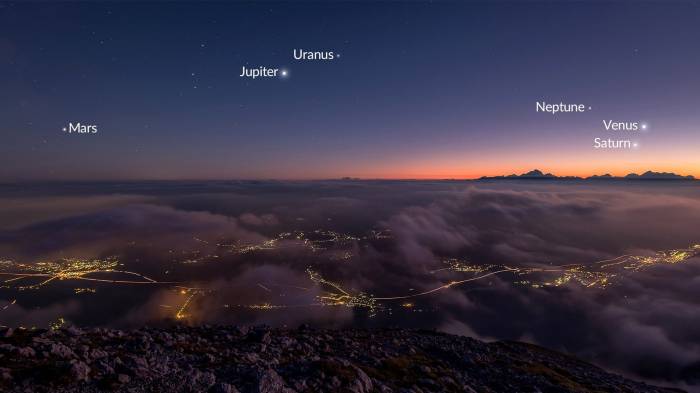
The 2025 planetary alignment, a celestial spectacle drawing considerable attention, is fundamentally rooted in well-understood scientific principles. This alignment isn’t a mystical event but a predictable consequence of the laws of physics governing our solar system. Understanding the phenomenon requires delving into orbital mechanics, gravitational forces, and the relative motions of celestial bodies.
Orbital Mechanics and Celestial Motion
The planets, including those involved in the 2025 alignment, follow elliptical orbits around the Sun. These orbits are governed by Kepler’s laws of planetary motion, which describe how planets move. The first law states that planets orbit the Sun in ellipses, with the Sun at one focus. The second law states that a line joining a planet and the Sun sweeps out equal areas during equal intervals of time, meaning planets move faster when closer to the Sun and slower when farther away. The third law relates the orbital period of a planet to the size of its orbit.
The apparent alignment we observe is a result of these planets, in their individual orbits, appearing to cluster together from our perspective on Earth. The planets don’t necessarily line up in a perfectly straight line in space; instead, they appear close to each other in the sky. The closer the planets’ orbital periods are, the more frequently these apparent alignments occur.
The timing of these alignments is calculated using sophisticated astronomical models that account for each planet’s position at any given time. These models are built upon decades of observational data and are continually refined as new data becomes available. These calculations allow astronomers to predict the positions of planets with remarkable accuracy.
The Sun’s Gravitational Influence
The Sun’s gravity is the dominant force shaping the solar system. It dictates the orbits of all the planets, including those participating in the 2025 alignment. The strength of the gravitational force between the Sun and a planet is described by Newton’s law of universal gravitation:
F = Gm1m2/r²
Where:
* F is the gravitational force
* G is the gravitational constant
* m1 and m2 are the masses of the two objects (Sun and planet)
* r is the distance between their centers.
This formula demonstrates that the gravitational force is directly proportional to the masses of the objects and inversely proportional to the square of the distance between them. This means that the Sun, with its enormous mass, exerts a powerful gravitational pull, keeping the planets in their orbits. Each planet’s orbital speed and period are a direct consequence of the Sun’s gravitational influence and its distance from the Sun. For instance, Mercury, being closest to the Sun, experiences the strongest gravitational pull and has the shortest orbital period, while Neptune, being farthest, experiences the weakest and has the longest orbital period. The Sun’s gravity is also responsible for the subtle perturbations in planetary orbits, causing slight deviations from perfect elliptical paths due to the gravitational interactions between the planets themselves.
Descriptive Illustration of the Solar System
Consider a simplified diagram representing the solar system, viewed from above, with the Sun at the center. The planets involved in the 2025 alignment, let’s assume they are Mercury, Venus, Earth, and Mars, are depicted as colored circles orbiting the Sun. Mercury is the smallest and innermost circle, followed by Venus, Earth, and then Mars, each in their respective orbits. The orbits are ellipses, with the Sun slightly off-center within each. The illustration includes arrows indicating the direction of each planet’s movement around the Sun, and each planet has a distinct color for easy identification. The diagram’s scale is not to actual distances but designed to illustrate the relative positions of the planets during the alignment. A label clearly identifies the Sun at the center and lists the planets involved, noting the date and time of the peak alignment as predicted by astronomical models. This visual aid simplifies the complex orbital mechanics, making it easier to grasp the concept of planetary alignment.
What are the potential challenges in observing the 2025 planetary alignment?
The celestial spectacle of the 2025 planetary alignment, while promising breathtaking views, presents several obstacles to terrestrial observers. Successfully witnessing this event requires careful planning and consideration of various factors that can significantly impact visibility. From the pervasive glow of artificial lights to unpredictable weather patterns and the observer’s geographic location, several challenges must be addressed to maximize the chances of a clear and unobstructed view of the alignment.
Obstacles to Visibility
Several factors can significantly hinder the observation of the 2025 planetary alignment. Light pollution, the most common culprit, washes out the night sky, obscuring fainter celestial objects. Weather conditions, particularly cloud cover, can completely block the view. The observer’s geographical location also plays a crucial role; the alignment’s visibility and duration vary depending on the observer’s latitude and the planets’ positions relative to the horizon. The time of the alignment relative to sunrise or sunset further complicates matters. Observing from a location near the equator will offer different perspectives compared to viewing from the poles.
Optimizing Viewing Conditions
To improve the chances of observing the 2025 planetary alignment, several strategies can be employed.
- Equipment Recommendations: Binoculars are ideal for observing the alignment, enhancing the visibility of the planets. A small telescope will provide more detailed views, allowing for the observation of planetary features. A tripod will help to stabilize any viewing equipment, especially if using binoculars or a telescope, improving image quality.
- Observing Locations: Choose locations away from city lights, preferably in areas with minimal light pollution. Dark sky sites, such as national parks or rural areas, offer the best viewing conditions. Consider the horizon; a location with an unobstructed view of the eastern and western horizons is essential.
- Timing Strategies: Consult astronomical resources to determine the exact time of the peak alignment and the planets’ rising and setting times. Plan to observe the alignment before dawn or after dusk when the sky is still relatively dark. Monitor the weather forecast and be prepared to travel to a location with clearer skies if necessary.
Global Viewing Conditions Comparison
The following table compares potential viewing conditions across different global locations. This table is for illustrative purposes, and actual conditions will vary.
| Location | Light Pollution | Weather Probability | Horizon Obstruction | Observing Time |
|---|---|---|---|---|
| New York City, USA | High | Moderate | Potentially Limited (buildings) | Short, near sunrise |
| Mauna Kea, Hawaii, USA | Low | Excellent | Excellent | Longer, ideal conditions |
| Sydney, Australia | Moderate | Variable | Potentially Limited (trees, buildings) | Good, after sunset |
| Giza, Egypt | Moderate | Good | Potentially Limited (pyramids, horizon) | Good, before sunrise |
How does the 2025 planetary alignment compare to other alignments that have occurred or are predicted?
The 2025 planetary alignment offers a compelling opportunity to study celestial mechanics and observe a rare astronomical event. Comparing it to past and future alignments provides context for its significance and helps assess its uniqueness. Understanding the frequency, duration, and planetary composition of such events is essential for appreciating their rarity and the scientific insights they offer.
Comparison of the 2025 Alignment with Historical and Predicted Events
Planetary alignments are not all created equal. Their rarity, duration, and the specific planets involved vary significantly. Some alignments involve a small number of planets and are relatively common, while others, involving several planets closely grouped, are exceptionally rare and draw considerable public interest. The 2025 alignment’s characteristics can be best understood by comparing it to historical and predicted events.
- Rarity and Frequency: True planetary alignments, where several planets appear close together in the sky, are infrequent. Alignments involving all the naked-eye planets (Mercury, Venus, Mars, Jupiter, and Saturn) happen approximately every few decades, though the degree of closeness varies. More significant alignments, including the addition of Uranus and Neptune, are exceedingly rare, occurring over centuries. For instance, the Great Conjunction of 1623, involving Jupiter and Saturn, was notable, though not a true alignment with all visible planets.
- Duration: The duration of an alignment is determined by the period over which the planets appear clustered. This is influenced by their orbital speeds and relative positions. Some alignments may last only a few days or weeks, while others, with slower-moving planets, might persist for months. The 2025 alignment is expected to have a relatively short duration, making the viewing window limited.
- Planetary Composition: The number and types of planets involved significantly affect the visual impact and scientific interest of an alignment. Alignments involving only the inner planets (Mercury, Venus, and Mars) are more frequent than those that include the gas giants (Jupiter and Saturn) or the ice giants (Uranus and Neptune). The 2025 alignment, involving several planets visible to the naked eye, offers a more accessible and visually striking experience than alignments involving only the outer planets.
Unique Characteristics of the 2025 Alignment
The 2025 planetary alignment has specific characteristics that distinguish it.
- Visual Closeness: The degree to which the planets will appear close together in the sky is a key factor. A tighter alignment offers a more dramatic visual spectacle. The 2025 event is expected to feature a reasonably close grouping, enhancing its visual impact.
- Observational Conditions: The visibility of the alignment from different locations on Earth will vary. Factors such as the time of year, the position of the Sun, and atmospheric conditions will influence the viewing experience.
- Scientific Significance: Each planetary alignment provides a unique opportunity for scientific study. Researchers can analyze planetary positions, gravitational interactions, and the effects of solar radiation on the planets.
Upcoming Planetary Alignments Timeline
Predicting planetary alignments requires precise calculations of planetary orbits. Here’s a glimpse at some upcoming alignments.
- 2026: A conjunction of Mars and Jupiter will be visible. This alignment will not involve a large number of planets but will still be a noteworthy celestial event.
- 2028: Jupiter and Saturn will appear close together in the sky, continuing a pattern of conjunctions between the gas giants. This event will offer a different visual perspective.
- 2040: A significant alignment involving several planets is anticipated. While specific details may evolve, this event is expected to be a highlight of the coming decades.
What is the potential impact of planetary alignment on the Earth’s environment or its inhabitants?
The convergence of celestial bodies in a planetary alignment sparks curiosity, often accompanied by speculation about its influence on Earth. While the visual spectacle is undeniable, it’s crucial to distinguish between scientific understanding and unsubstantiated claims regarding its effects. This section explores the scientifically established impacts, debunks common misconceptions, and presents the consensus view on the alignment’s influence.
Gravitational Influence and Earth’s Environment
The primary scientific consideration regarding planetary alignment’s impact is gravitational influence. The combined gravitational pull of multiple planets, particularly when aligned, could theoretically exert a force on Earth. However, the magnitude of this effect is significantly limited. The gravitational forces exerted by other planets on Earth are minuscule compared to the gravitational pull of the Sun and the Moon. These two celestial bodies are the dominant forces influencing Earth’s environment, particularly tides. The combined gravitational influence of all the other planets during an alignment is often less than the gravitational influence of a minor solar flare.
The effect on Earth’s environment is practically negligible. Consider the 2012 alignment, which triggered numerous doomsday predictions. The gravitational impact of the aligned planets was far less significant than the daily tidal variations caused by the Moon. The Moon, being much closer and more massive, has a far greater influence on Earth’s oceans, causing tides. Even the combined gravitational force of all the planets during a close alignment wouldn’t be noticeable. This can be compared to the gravitational influence a person has on the planet – virtually zero.
Misconceptions and Exaggerated Claims
A common misconception is that planetary alignments cause natural disasters like earthquakes, volcanic eruptions, or extreme weather events. There is no scientific evidence to support this claim. These events are driven by complex geological and atmospheric processes that are independent of planetary alignment. Another misconception is that alignments influence human behavior or create societal upheaval. Astrology, which often promotes these ideas, is not a science. It is a system of beliefs that does not adhere to scientific principles. These claims often gain traction during such events, fueled by media hype and a lack of scientific understanding.
The exaggeration of planetary alignment effects often stems from a misunderstanding of scale and the nature of scientific evidence. For example, during the 1982 planetary alignment, some predicted massive earthquakes. However, no significant seismic activity was directly correlated with the alignment. Such claims are frequently promoted through anecdotal evidence, which lacks the rigor of scientific methodology. This contrasts with the scientific method, which relies on testable hypotheses and empirical data.
Scientific Consensus on Planetary Alignment’s Influence
The scientific consensus is that the gravitational effects of planetary alignments on Earth are negligible. While the combined gravitational pull of other planets is present, it is far outweighed by the Sun and the Moon’s gravitational forces. There is no credible scientific evidence to support the claim that planetary alignments directly cause natural disasters or significantly impact human behavior. The primary impact is a visual one, offering a unique opportunity to observe celestial bodies in a rare configuration.
Epilogue
In conclusion, the planetary alignment of 2025 represents more than just a fleeting astronomical event; it is a convergence of science, history, and human curiosity. From the intricate calculations required to predict its occurrence to the potential for awe-inspiring visual displays, this alignment offers a unique opportunity to connect with the cosmos. As we anticipate this celestial spectacle, it is essential to appreciate both the scientific explanations and the cultural narratives that enrich our understanding of the universe and our place within it.
